Written By: Laurie LaVassar, Teacher on Special Assignment (TOSA), Elementary
Walk into a kindergarten classroom on a “tile day,” and you may notice something different. Students lean in, reach eagerly for letters, and anticipate the next word they will build. For young learners, the simple act of moving letters across a board can transform a phonics lesson from something they watch and listen to into something they actively do.
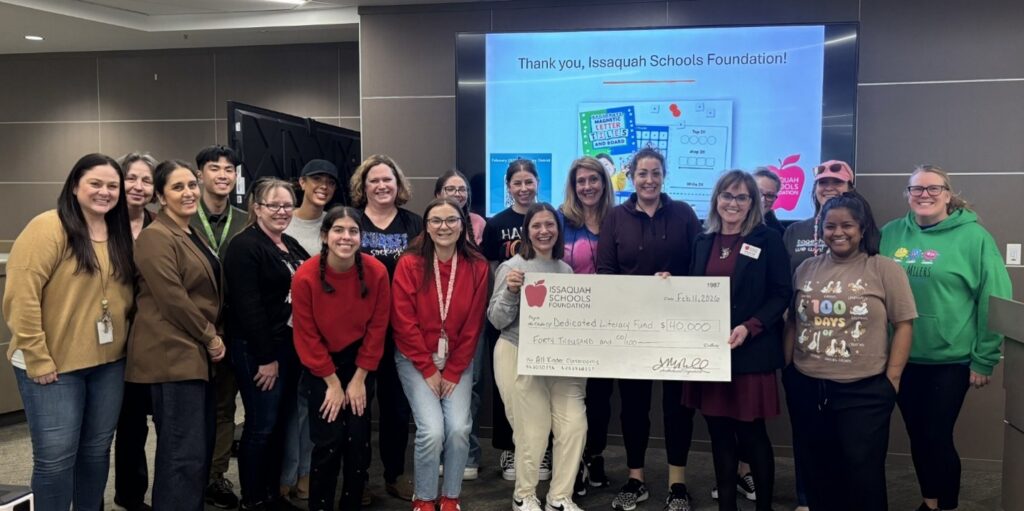
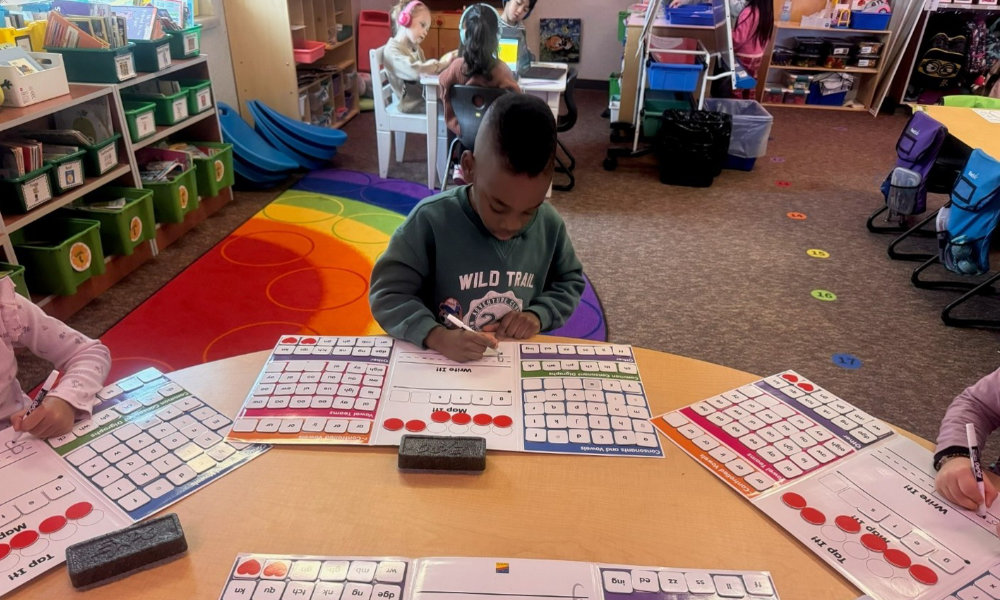
Thanks to the Issaquah Schools Foundation’s generous literacy funding, kindergarten students across the district have access to Benchmark Magnetic Letter Tiles and Boards, a hands-on tool that brings foundational reading skills to life.
For many students, these tiles are more than a classroom material. They provide a tangible way to explore how spoken sounds connect to written letters and how those letters come together to form words. Rather than simply viewing a word on a page, students can build it, break it apart, change it, and rebuild it. Through this process, they develop the foundational skills that support reading and writing.
Ms. Afmin, a kindergarten teacher at Newcastle Elementary, shared:
“[Benchmark Magnetic Letter] Tiles have been a valuable tool in my kindergarten classroom, especially when supporting students as they develop foundational literacy skills through Benchmark Advance. The hands-on tiles give students a concrete way to build, manipulate, and break apart words while strengthening their understanding of letter-sound relationships, phonemic awareness, and word formation. My kindergartners are able to physically move the tiles as they segment sounds, blend sounds together, and create new words, making literacy concepts more accessible and engaging.”
When Engagement Supports Learning
That enthusiasm matters.
When students light up at the sight of the Magnetic Letter Tiles and Boards, ask whether it is going to be a “tile day,” or choose to work with letters and words during purposeful play, we are seeing more than excitement for a favorite classroom activity. We are seeing students actively engage with the building blocks of literacy.
The Magnetic Letter Tiles and Boards are designed to enhance the high-quality literacy instruction already taking place through Benchmark Advance. They do not replace explicit phonics instruction, the curriculum, or the teacher’s expertise. Instead, they provide another way for students to practice and apply what they are learning.
Imagine a lesson introducing a new sound-spelling pattern. Students hear the sound, learn the corresponding letter, read words containing the pattern, and practice blending and segmenting sounds. The tiles offer a hands-on opportunity to engage with that same learning.
A teacher might say:
- “Build sat.”
- “Now change sat to sit.”
- “Now change sit to sip.”
With each change, students identify the sound that has changed, locate the corresponding letter, manipulate the tiles, and reread the word. The activity is not separate from the curriculum. It is another representation of the same learning, helping students connect what they hear, say, read, and write.
This is especially important in kindergarten, when students are simultaneously learning letter-sound correspondences, phonemic awareness, blending, segmenting, reading, and spelling. Having a concrete way to represent sounds and letters helps make these complex ideas more accessible.
Research supports this approach. Effective early literacy instruction includes explicit phonemic awareness and systematic phonics instruction, particularly when students use letters to manipulate sounds within words. The National Reading Panel and the Institute of Education Sciences both highlight the value of instructional practices that allow students to represent and manipulate phonemes with letters as they learn to read and spell.
The Magnetic Letter Tiles and Boards provide a practical way to bring these evidence-based practices to life while keeping students engaged in meaningful literacy learning.
From Small Group Instruction to Purposeful Play
Perhaps one of the most exciting outcomes is what happens when the lesson ends.
Students continue to choose the tiles on their own.
One child might build a friend’s name. Another may create words using familiar sound patterns. A group of students may challenge one another to make new words. A student who has been practicing a particular sound may begin searching for that letter independently.
These moments matter because students are applying literacy skills in authentic ways.
When letters and words become part of purposeful play, students begin to view literacy as something they can use, explore, and create with, not simply something they do during reading time.
A student who builds a word is practicing.
A student who changes one letter to create a new word is practicing.
A student who notices, “I need the /t/ at the end,” is practicing.
The literacy thinking is real. Through play, exploration, and hands-on practice, students are strengthening the foundational skills that support future reading success.
Thanks to the continued support of the Issaquah Schools Foundation, our youngest learners have access to engaging, research-based tools that transform literacy learning from something students observe into something they experience, explore, and own.